

Training as an umbrella employment consultant is the blind spot of many freelance careers: absorbed by missions, you postpone upskilling… until the market moves past your stack. Umbrella employment gives you a decisive edge over classic self-employment here: you are an employee, so you accumulate CPF training rights, you can tap your umbrella company's skills development plan, and the sector's training body (OPCO) co-funds certain programmes.
This guide covers the funding levers actually available in 2026, a method for choosing training that raises your daily rate, and how to turn a between-mission period into an investment rather than dead time.
Umbrella employees get full training rights
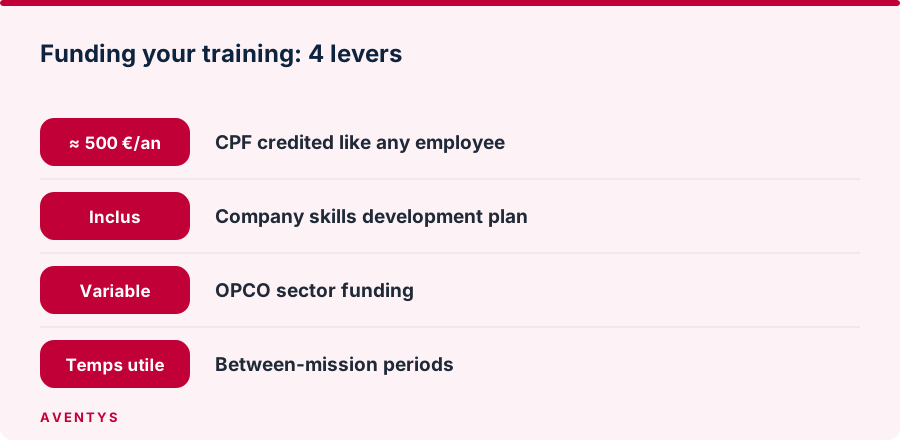
Unlike a micro-entrepreneur who self-funds most training, an umbrella employee benefits from the standard employee training regime. Three mechanisms combine:
- The CPF (personal training account): credited for every year worked, at around €500 per year for full-time activity, up to a cumulative cap;
- The skills development plan of your umbrella company: as your employer, it has a stake in maintaining your employability;
- Sector funding (OPCO): depending on the sector's priorities and available budgets, certain certifying programmes are co-funded.
If the overall mechanics of the status are still unclear, start with our guide on how umbrella employment works — the training funding logic flows directly from it.
The umbrella consultant's CPF: how it works
How your rights accumulate
Every year of salaried activity under umbrella employment credits your personal training account, exactly like any other employee. Your previous salaried years count too: many IT consultants arrive in umbrella employment with several thousand euros of rights already available — often without knowing it. First action: check your balance on the official training account portal.
What the CPF usefully funds in IT
The CPF funds certifying programmes registered in the official directories: cloud, security, data, project management and language certifications. Beware the classic trap: a fashionable course that the market does not recognise is worth neither your rights nor your time. The question is not \"what interests me?\" but \"what will justify a higher daily rate at my next negotiation?\".
The other funding routes: skills plan and OPCO
Skills development plans vary widely between umbrella companies: some offer an online catalogue, workshops (negotiation, consulting posture, prospecting) or even an annual budget per consultant. It is an underrated selection criterion when comparing providers — on a par with management fees and tooling.
OPCO funding is processed through your umbrella company: it builds the application file. A responsive advisor can get an expensive certification co-funded; ask before mobilising your CPF, as the order in which budgets are used changes what you pay out of pocket.
Choosing training that actually raises your daily rate
Training is an investment whose return is measured in daily-rate points. The method: start from market rate grids, identify skills where demand exceeds supply, and check the rate gap between your current profile and the target profile.
| Domain | Certification examples | Observable rate effect |
|---|---|---|
| Cloud | AWS / Azure / GCP architect tracks | Strong — architect profiles in high demand |
| Cybersecurity | Recognised security certifications | Strong — structural shortage |
| Data / AI | ML, data engineering, generative AI | Strong to very strong with seniority |
| Project management | Scaled agile, PMP | Moderate — differentiating in large accounts |
| Languages | Certified professional English | Moderate — opens international missions |
A rare skill only pays off if you monetise it at the right moment: revisit our method to set your daily rate, then measure the impact of a €50 daily increase in the daily rate calculator — over a full year, the gap far exceeds the cost of most certifications.
Training between missions: turning the gap into a springboard
The between-mission period is ideal for longer programmes: no schedule conflict with a client, available energy, and a direct effect on your return-to-market pitch. Three reflexes:
- Plan before the mission ends: enrol while you are still billing, so training starts in the first week of the gap;
- Alternate certification and practical work: a demonstrable lab or project weighs more than a badge in a client interview;
- Capitalise immediately: update your CV, profile and rate pitch as soon as you certify — an invisible certification earns nothing, as our guide to high-value IT missions shows.
Structuring your watch between two programmes
Certifying training is the highlight; continuous watch is the thread that makes it profitable. A sustainable rhythm: one hour of structured watch per week (reference newsletters, release notes of your stack, one technical talk), one side project per quarter, and a six-monthly self-assessment of your market positioning. This short cycle avoids the cliff effect — discovering after a two-year mission that the market has moved on.
FAQ: training and umbrella employment
Do umbrella employees really earn CPF rights?
Yes. The CPF is credited for any salaried activity, umbrella employment included, at around €500 per year full time, up to the regulatory cap. Previously earned rights remain yours.
Who pays for training: me or the umbrella company?
It depends on the lever: your CPF (personal rights), the skills development plan (company budget), OPCO co-funding, or a combination. Ask for an out-of-pocket simulation before enrolling.
Can I train during a mission?
Yes, by arranging the calendar with your client — evenings, non-billed days or mission smoothing. Many consultants keep long programmes for between-mission periods and short formats during missions.
Does a certification automatically raise my daily rate?
No: it makes a move upmarket credible, which you then have to negotiate — at renewal or on the next mission. The certification is the argument; negotiation turns the argument into euros.
Want a training plan aligned with your rate objectives? Talk to an Aventys advisor: we know which certifications matter on the France-Luxembourg IT market.