

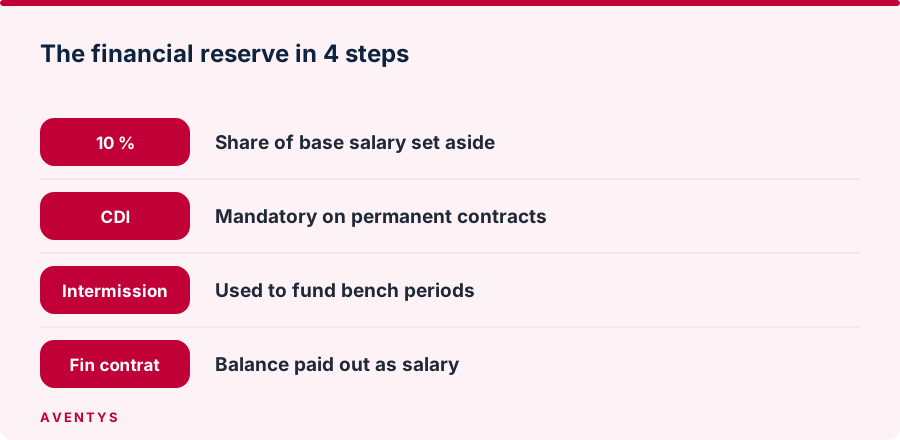
The financial reserve in umbrella employment is one of the least understood mechanisms of the status, yet it directly shapes your income security. Under the French umbrella-industry collective agreement of 22 March 2017, the umbrella company must set aside, for every consultant on a permanent contract (CDI), the equivalent of 10% of the base salary of the latest assignment. Its purpose: keeping your pay from dropping to zero between assignments.
For an IT consultant whose revenue swings from month to month — a long assignment, a bench period, a daily-rate renegotiation — this reserve is also a management tool. Used well, it lets you smooth your salary across the year and stabilise your borrowing capacity. Here is how it is calculated, what it funds, how permanent and fixed-term contracts differ, and when you get the money back.
Financial reserve in umbrella employment: definition and legal framework
The financial reserve is a provision built by the umbrella company on your activity account. Made mandatory by the industry collective agreement of 22 March 2017 for every umbrella employee on a permanent contract, it equals 10% of the base salary of your latest assignment: a fraction of your revenue is not converted into salary straight away and secures the months without invoicing.
The logic: in umbrella employment, your employer owes you no salary without an assignment. The reserve therefore guarantees a minimum remuneration while you prospect for the next contract.
Financial reserve versus financial guarantee
The financial guarantee is a legal obligation imposed on every umbrella company (Article L1254-26 of the French labour code): it protects your salaries and contributions if the company fails. The financial reserve, by contrast, is funded with your own revenue: the first protects you against the umbrella company's insolvency, the second against your own gaps in activity.
How the reserve is calculated: 10% of base salary on a permanent contract
The rate is set by the collective agreement: 10% of the base salary of your latest assignment, meaning gross remuneration excluding variable items.
Take an IT consultant invoicing a daily rate of €600 over 18 days a month — €10,800 of revenue excluding VAT. After management fees (5 to 10% of invoiced revenue, often degressive), roughly €10,000 remains to be converted into pay. Once employer contributions are deducted (around 42% of gross), the monthly gross salary lands in the region of €7,000: the reserve is then about €700 per month, more than €8,000 of safety cushion over a 12-month assignment — enough to fund one to two months on the bench. For the full revenue-to-net chain, see our method to calculate your net salary in umbrella employment.
Where does the reserve appear?
On your monthly activity-account statement, which details revenue collected, management fees, salaries paid, professional expenses reimbursed and the reserve built to date. If this line is missing, ask for it — it is your money.
What does this safety cushion actually fund?
The financial reserve serves three concrete purposes for an IT consultant:
- Funding bench periods: between two contracts, the umbrella company draws on the reserve to keep paying you a salary, where a classic freelancer would earn nothing.
- Smoothing your salary: you deliberately leave part of your revenue on the activity account and draw a constant salary all year round.
- Preserving your social rights: as long as a salary is paid, your pension contributions (general scheme plus Agirc-Arrco), disability cover and health insurance keep accruing on your actual salary.
An often decisive side effect: stable payslips. A banker reads twelve regular payslips far more favourably than nine high ones followed by three months at zero.
Permanent or fixed-term contract: reserve or end-of-contract bonus?
On a permanent umbrella contract, the reserve is provisioned continuously and mobilised during bench periods. On a fixed-term contract there is no reserve as such: the contract ends with the assignment and you receive an end-of-contract indemnity. Same goal — compensating discontinuity — opposite logics.
| Criterion | Permanent umbrella contract | Fixed-term umbrella contract |
|---|---|---|
| Mechanism | Financial reserve provisioned | End-of-contract indemnity |
| Amount | 10% of base salary (22 March 2017 agreement) | In the region of 10% of total gross pay |
| When | Built each month worked, used between assignments | Paid in one instalment when the contract ends |
| Purpose | Fund bench periods, smooth income | Compensate the precariousness of a short contract |
| Payback | Balance released when the contract ends | Not applicable (automatic payment) |
For an IT consultant chaining assignments, the permanent contract and its reserve offer a continuity the fixed-term route cannot match: see our comparison of permanent vs fixed-term umbrella contracts.
When and how is the reserve paid back?
The reserve never belongs to the umbrella company. Three key moments:
- Between assignments: the reserve funds your remuneration during periods without a client contract, automatically.
- During the contract: depending on the umbrella company, the activity-account surplus above the mandatory reserve can be released as salary or bonus.
- When the contract ends (resignation, mutual termination, dismissal): the full balance, reserve included, is paid out in your final settlement as salary, subject to the usual contributions (employee contributions of around 22%).
One essential point: the reserve, once paid, is salary in the full sense — subject to contributions, hence generating rights. If your contract ends in conditions that open unemployment rights, those amounts feed into your benefit calculation: see umbrella employment and unemployment: your ARE rights.
Smoothing your salary across the year: the constant-income strategy
The 10% mandatory reserve is a floor, not a ceiling: nothing stops you provisioning more to build genuine salary smoothing.
A concrete example: a consultant with irregular revenue
A backend developer invoices €10,000 excluding VAT per month for 9 months, then spends 3 months on the bench. Annual revenue: €90,000. With overall net pay typically between 47 and 52% of invoiced revenue, the annual net envelope sits roughly between €42,000 and €47,000. Two ways to draw it:
- Without smoothing: around €4,700 to €5,200 net per month for 9 months, then close to nothing for 3 months, beyond the minimum reserve.
- With smoothing: a stable salary in the region of €3,500 to €3,900 net over 12 months, fed by invoicing in worked months and by the activity account in lean ones.
The annual total is identical; what changes is regularity: a solid mortgage file, uninterrupted social contributions, and the calm to negotiate the next assignment without discounting your daily rate.
Smoothing best practices
- Set your target salary on a prudent assumption: 10 to 11 invoiced months per year, not 12.
- Keep the equivalent of 2 to 3 months of salary on the activity account before releasing exceptional bonuses.
- Anticipate known end dates: increase the provision 2 to 3 months before the assignment ends.
FAQ: your questions about the financial reserve
Do I lose the reserve if I leave my umbrella company?
No. It is funded with your own revenue: when the contract ends, the balance is paid back to you as salary in your final settlement, after social contributions.
Does the financial reserve earn interest?
No. It is a provision on your activity account, not an investment. Its value is insurance-like — income continuity — not financial return.
Can I opt out of the reserve on a permanent contract?
No. The 10% of base salary is a mandatory rule of the collective agreement for permanent umbrella contracts. You can, however, provision more.
Does the reserve count towards my pension and unemployment rights?
Yes, as soon as it is paid out as salary: subject to contributions, it feeds your pension rights (general scheme and Agirc-Arrco) and your unemployment rights.
Want to measure what smoothing would do to your real take-home pay? Test several scenarios with our umbrella employment salary calculator, then book a call with an Aventys advisor to calibrate your reserve strategy.