

Invoicing in umbrella employment is one of the great reliefs of the status: you do not create invoices, you do not chase late payers, you do not run after your cash flow. But delegating does not mean ignoring: understanding the cycle — from activity report to salary payment — spares you bad surprises and gives you the right reflexes when a client drags their feet.
Here is the complete billing cycle, the legal payment terms, the two salary payment models and what to do about unpaid invoices.
Who invoices whom: consultant, umbrella company, client
Umbrella employment is a three-way relationship. You deliver the mission and negotiate its commercial terms; the umbrella company contracts with the client, issues invoices in its own name and turns collected revenue into salary; the client pays the umbrella company, not you. This architecture — detailed in our guide on how umbrella employment works — explains everything else: no business registration to manage, no VAT returns, no bookkeeping.
Your only monthly obligation: the timesheet.
The timesheet (CRA), linchpin of the billing cycle
What an activity report contains
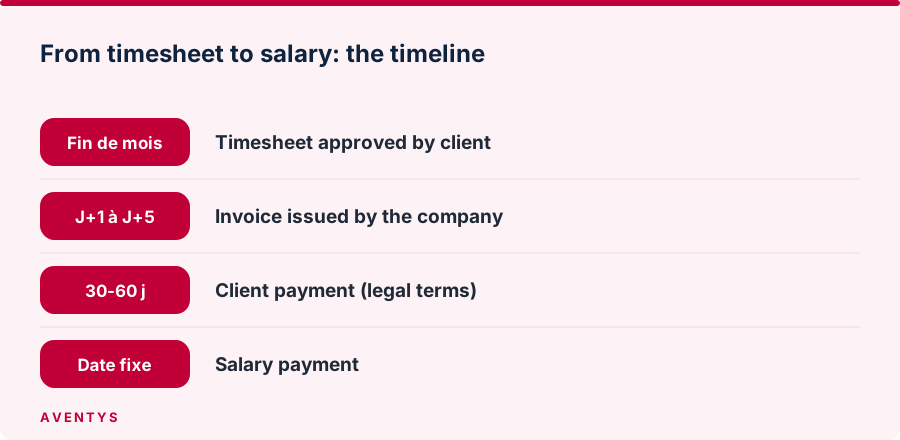
The CRA (activity report) lists the days — or half-days — worked in the month, any absences and, depending on the mission, expenses rebillable to the client. Submitted at the end of the month through your umbrella company's online portal, it is approved by the client and then serves as the supporting document for the invoice.
The three mistakes that delay your pay
- A late timesheet: every day of delay mechanically pushes back the invoice, and therefore collection;
- A timesheet that does not match the contract: days billed outside the contractual period, unplanned expenses — the client rejects it and the loop restarts;
- A forgotten client approval: chase your contact yourself; it is the one point in the cycle where your direct action matters most.
Payment terms: what the law says, what the market does
Between businesses in France, payment terms are legally capped: 60 days from the invoice date (or 45 days end-of-month where the contract provides for it). Absent any clause, the default term is 30 days. In practice, large accounts and consultancies often settle at 45 to 60 days — a parameter to negotiate alongside your daily rate: a brilliant rate paid at 60 days can be worth less than a decent rate paid at 30.
Good news: the umbrella company carries that cash-flow gap, not you — provided you choose the right salary payment model.
Salary before or after client payment: the two models
Not all umbrella companies manage cash flow the same way. Two approaches coexist:
| Model | How it works | Consequence for you |
|---|---|---|
| Fixed-date salary | The company smooths cash flow and pays salary on an agreed date each month, whether or not the client has paid | Regular income, genuine employee-grade security |
| Salary after collection | Salary is only triggered once the client has settled the invoice | Income exposed to the client's terms (and delays) |
\"Do you pay salary before client collection?\" belongs on any shortlist of questions before signing an umbrella agreement. A fixed-date payroll genuinely turns your revenue into predictable salary; to measure what that salary represents, use the net salary calculator or revisit our method to calculate your net salary.
Late and unpaid invoices: who handles them, how you are protected
When a payment is late, the umbrella company runs its collection procedure: written reminders, late-payment penalties provided for in the commercial contract, formal notice, litigation if needed. You do not intervene directly — that is precisely the service your management fees pay for.
Two safety nets complete the setup:
- The mandatory financial guarantee (article L1254-26 of the French labour code): it secures the payment of salaries and contributions even if the umbrella company itself fails;
- The financial reserve built up in your activity account (10% of base salary on permanent contracts), which cushions gaps between missions.
A structurally bad payer remains a commercial red flag: your umbrella company may require a deposit at kick-off or tighten terms at renewal. Listen to its feedback — it sees hundreds of payers go by.
Rebillable expenses: the bonus line on your invoice
Travel to the client site, mission-specific equipment, licences imposed by the assignment: these costs can be rebilled to the client on top of your daily rate when the commercial contract provides for it. Rebilled, they carry neither management fees nor contributions — a net-pay lever too often forgotten at negotiation time. The full detail is in our guide to professional expenses in umbrella employment.
FAQ: invoicing and payment in umbrella employment
Do I issue the invoices myself in umbrella employment?
No. The umbrella company issues invoices in its own name, based on your approved timesheet. You have no VAT number to manage and no sales ledger to keep.
What if my client pays at 60 days?
That is lawful where the contract provides for it (60-day cap from invoice date). With fixed-date payroll providers, it does not affect your pay: the company carries the cash-flow gap.
Can an unpaid client invoice block my salary?
Under the \"salary after collection\" model, yes — its main weakness. Under the fixed-date model, no: collection is the umbrella company's job, and the mandatory financial guarantee secures salaries as a last resort.
Can I invoice a deposit at the start of a mission?
Yes, if the commercial contract provides for it: common practice on long missions or with new clients. Raise it with your advisor at contracting time.
A question about the billing calendar of your next mission? Book a call with an Aventys advisor: we walk you through the exact timeline, from first timesheet to first salary.