

How you choose your umbrella company shapes your daily life as an IT contractor more than almost any other decision — sometimes more than your daily rate itself. On identical invoiced revenue, two umbrella companies produce net pay that differs by several hundred euros a month — and levels of reliability that are simply not comparable.
This guide walks through the 8 decisive criteria for comparing umbrella companies: the mandatory financial guarantee, management fees, simulation transparency, the PEPS label, tools, support, professional liability insurance and payroll reliability. It closes with the red flags that should make you walk away, a reusable comparison grid, and the questions to ask before signing.
Why the umbrella company you choose changes your net pay
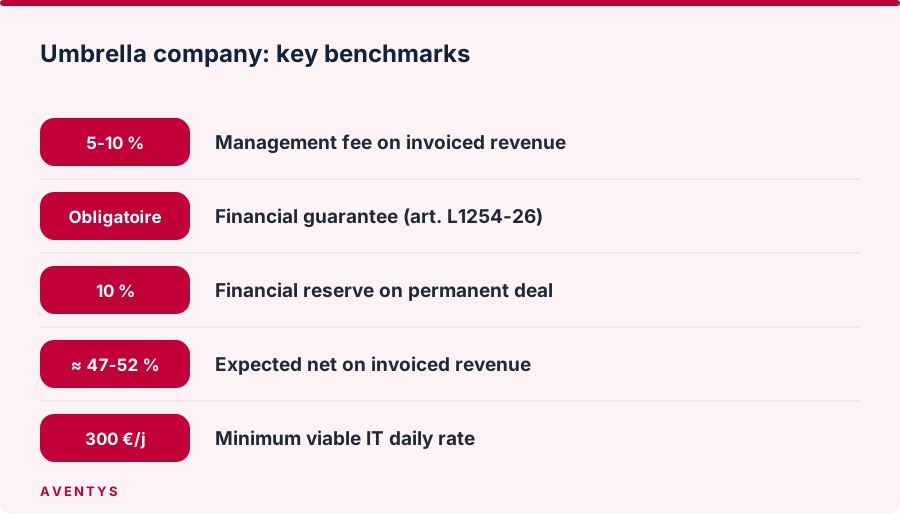
The mechanics are straightforward: the umbrella company deducts a management fee of 5 to 10% of your invoiced revenue (excluding VAT), then converts the remainder into salary after employer contributions (around 42% of gross) and employee contributions (around 22%). Your net typically lands at around 47 to 52% of invoiced revenue, before any expense optimisation — the full mechanics are covered in our guide on calculating your net salary in umbrella employment.
In practice: at a €600 daily rate over 19 billed days, you generate €11,400 in monthly revenue. A two-point fee difference (8% versus 6%) is worth €228 per month — in the region of €2,700 per year.
Criteria 1 and 2: the legal and professional foundations
The financial guarantee: mandatory, and verifiable
Every umbrella company operating under the French framework must hold a financial guarantee from an authorised institution (article L1254-26 of the French Labour Code). It secures your salary and social contributions if the company defaults. Demand the current certificate, naming the guarantor and the amount covered: a provider that cannot produce it is eliminated on the spot.
The PEPS label and certifications
Membership of PEPS, the sector's reference trade body, signals a commitment to the umbrella employment collective agreement of 22 March 2017 and to professional standards. It is not an absolute guarantee, but its absence at an established player deserves an explanation. Also check how long the company has operated and whether its accounts are published: you are entrusting it with your cash flow.
Criteria 3 and 4: management fees and simulation transparency
Management fees: the rate, the sliding scale, the cap
The market ranges from 5 to 10% of invoiced revenue. Three questions make the difference: does the rate decrease as your billed volume grows? Is there a cap in euros — decisive for high daily rates? And above all, does the headline rate cover everything? Some providers offset a low teaser rate with side charges: file fees, per-payslip fees, commissions on professional expenses, separately billed liability insurance. The only figure that matters is your total annual cost as a share of revenue.
Demand a line-by-line simulation
Before signing anything, request a written simulation on your actual daily rate, with every line visible: invoiced revenue, management fee, employer contributions, gross salary, employee contributions, the financial reserve (10% of base salary on permanent contracts, required by the collective agreement), and net before income tax. A serious provider delivers it within hours; one that answers with a single percentage — "you'll take home 55%" — is hiding something. Also check how professional expenses are handled, a major net-pay lever.
Criteria 5 and 6: everyday tools and genuine support
Online portal, timesheets and e-signature
Ask for a demo before committing: online timesheet (CRA) submission, electronic signature for contracts, real-time visibility of your activity account, and paperless expense claims. An outdated back office means e-mail ping-pong, data-entry errors and delayed payslips.
Support, advice and network
A good umbrella company is not a payslip factory. A dedicated account manager, contract reviews before you sign with a client, net-pay advice, chasing late-paying clients: that is what separates a partner from a processor. For an IT contractor, a tech-specialised provider understands your world and can open its network of qualified missions to you.
Criteria 7 and 8: liability insurance and payroll reliability
Professional liability: included or billed extra?
Professional liability insurance is essential in IT consulting: a design error or an outage caused at a client site can be very expensive. Check that cover is included in the management fee, that the limits fit enterprise-level missions, and that your field of work is covered.
Payroll: the real reliability test
Ask precise questions: on what date is salary paid? Does payment depend on the client actually settling the invoice, or does the company smooth cash flow? How quickly is the payslip produced after timesheet approval — the best providers manage it within a matter of days? Talk to contractors already on board: recurring payroll delays are the most cited complaint in negative reviews.
Red flags that should make you walk away
- Promised net pay above 60% of revenue without significant professional expenses: mathematically implausible, usually a sign of risky schemes.
- No financial guarantee certificate produced on request, or an expired document.
- Aggressive "optimisation" schemes: you carry the compliance risk, not the company.
- A single global percentage instead of a line-by-line simulation, or side fees discovered after signing.
- Sloppy contracts exposing you to the risks covered in our article on avoiding disguised employment reclassification.
- Recurring reviews mentioning late payroll or unreachable support.
The comparison grid and the questions to ask
| Criterion | What to demand | Red flag |
|---|---|---|
| Financial guarantee | Current certificate (art. L1254-26) | Document not provided |
| Management fees | 5-10% all inclusive, sliding scale, known cap | Side fees outside the headline rate |
| Simulation | Line-by-line detail on your daily rate | Single global percentage |
| Label | PEPS membership, published accounts | Opaque, recently created structure |
| Tools | Online timesheets, e-signature, real-time account | E-mail and spreadsheet workflows |
| Support | Dedicated contact, IT specialisation | Anonymous hotline |
| Liability insurance | Included, enterprise-grade limits | Billed as an optional extra |
| Payroll | Fixed, contractual payment date | Payment conditional on client settlement |
Questions to ask before signing
- Can you send me your financial guarantee certificate and a line-by-line simulation on my daily rate?
- Is your management fee all inclusive, degressive, capped?
- On what date is payroll run, and does it depend on client payment?
- Is professional liability insurance included, and does it cover my IT missions?
- Can I try the online portal before committing?
FAQ: how to choose your umbrella company
What management fees are normal in umbrella employment?
Between 5 and 10% of invoiced revenue, often on a sliding scale and sometimes capped in euros. Below 5% "all inclusive", look for hidden charges.
How do I verify an umbrella company's financial guarantee?
Request the certificate issued by the guarantor (a bank or insurer), and check its validity date and the amount covered. It is a legal obligation under article L1254-26: refusal to produce it disqualifies the provider.
Can I switch umbrella companies later?
Yes. At the end of a mission — or sometimes mid-mission, with a transfer of the commercial contract — you can move to another provider. Plan for the release of your financial reserve and the continuity of your rights.
Is an IT-specialised umbrella company better than a generalist?
For a tech contractor, usually yes: contracts built for intellectual services, liability cover calibrated for digital work, a realistic view of market daily rates (rarely viable below around €300 per day) and a network of qualified missions.
Before comparing providers, put numbers on your own situation: our net salary calculator gives you a line-by-line projection in two minutes. Then test your simulations against expert eyes — book a call with an Aventys advisor, specialists in IT umbrella employment across France and Luxembourg.