
Talent skilled employee vs EU Blue Card: the right permit for a foreign developer
You are a developer, software engineer, data engineer or cloud architect, you are not a national of an EU member state, and a French company wants to hire you. Two variants of the talent passport are open to you, and the choice between the talent skilled employee permit and the EU Blue Card deserves a clear answer before you apply. Both permits let you work without a separate work authorisation, are requested online and cover several years — but they differ on degree requirements, minimum contract length and salary.
The "talent passport" is the common name for the multi-year residence permit bearing the "talent" mention, overhauled by the French law of 26 January 2024 and its 2025 implementing texts. This article compares, point by point, the talent – skilled employee variant and the talent – EU Blue Card variant for a tech profile, so you can pick the route that best fits your degree, your contract and your European mobility plans. For the full picture of every variant, our talent passport guide for IT consultants sets the scene.
Talent – skilled employee: built for a qualified role in France
The skilled-employee variant is designed for a foreign national hired into a role matching their qualifications. Two conditions frame access: a degree at least equivalent to a master's level, and an employment contract of at least three months with an employer established in France. Pay must reach a threshold set by reference to an average annual gross salary; as an indicative figure for 2026, that floor sits around 39,582 euros gross per year, an amount reassessed each year by decree.
This variant actually covers several closely related situations. An employee of a young innovative company, and an intra-group mobility employee — seconded or assigned from a company in the same group with at least three months of seniority outside France — follow similar logic. For a software engineer hired on a permanent contract or a long fixed-term contract in a qualified role, this is often the most direct entry point: the salary threshold is more accessible than the Blue Card's, and a master's-level degree is enough, with no alternative experience required.
Talent – EU Blue Card: highly qualified employment and mobility across the EU
The EU Blue Card is France's version of a scheme shared across the Union, created to attract highly qualified talent. It requires highly qualified employment covered by a contract of at least six months. On qualifications, there are two routes: either a degree reflecting at least three years of higher education, or comparable professional experience recognised in the relevant sector — a valuable flexibility for tech profiles who took shorter study paths but built solid hands-on experience.
The trade-off for that flexibility is a higher salary threshold: derived from a 1.5 coefficient applied to the reference salary, it sits, as an indicative figure for 2026, around 59,373 euros gross per year. In return, the EU Blue Card offers something the skilled-employee variant does not: intra-EU mobility. After a period of residence in the first member state, the holder can, under certain conditions, settle and work in another Union country that has adopted the scheme. That makes it especially attractive for consultants who work across several European markets.
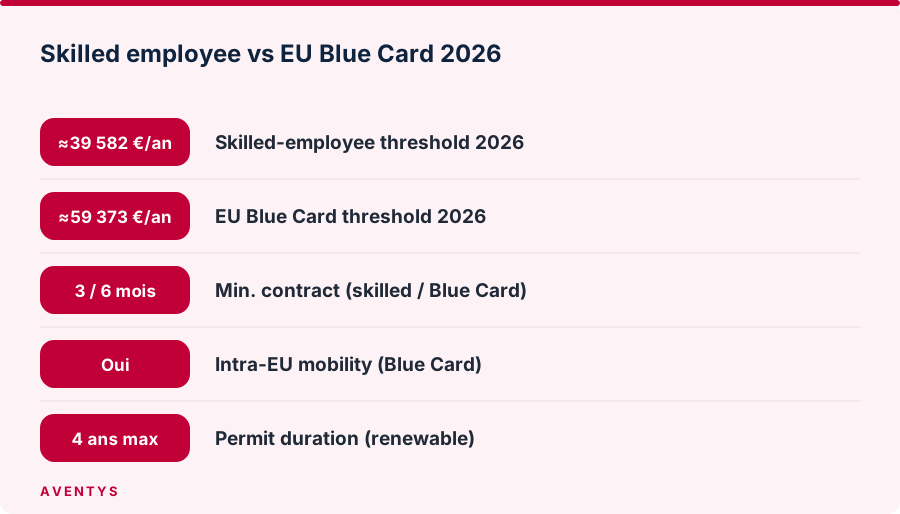
Comparison table: talent skilled employee vs EU Blue Card
| Criterion | Talent – skilled employee | Talent – EU Blue Card |
|---|---|---|
| Target audience | Qualified role in France | Highly qualified employment |
| Degree | At least equivalent to a master's level | Three-year higher-education degree OR comparable experience |
| Minimum contract length | 3 months | 6 months |
| Pay (indicative, 2026) | Around 39,582 euros gross/year | Around 59,373 euros gross/year (1.5 coefficient) |
| Intra-EU mobility | Not covered by this variant | Yes, under conditions |
| Permit duration | Up to 4 years, renewable | Up to 4 years, renewable |
| Prior work authorisation | Not required | Not required |
| Typical IT profile | Qualified permanent/fixed-term role, intra-group mobility, young innovative company | Very well paid or very experienced profile, multi-country projects |
2026 salary thresholds: indicative figures, indexed each year
Neither of the amounts above is fixed for good. Since the order of 21 August 2025, the thresholds are indexed to a reference average annual gross salary and reassessed every year. The 2026 figures — roughly 39,582 euros for the skilled employee, roughly 59,373 euros for the Blue Card — should therefore be read as indicative benchmarks that may rise. Before submitting any application, check the current amount on service-public.fr or on the ANEF online service, which are the authoritative sources.
The key takeaway is the mechanism: the Blue Card applies a 1.5 coefficient to the reference salary, which explains its noticeably higher floor. In practice, an IT consultant whose pay comfortably clears the skilled-employee threshold without necessarily reaching the Blue Card level will naturally lean toward the first variant; conversely, a very well paid senior profile may aim for the Blue Card to unlock European mobility.
How to choose between the two variants
The right approach is to reason from three concrete variables: your degree, your salary level and your geographic plans.
- You hold a master's and a salary within the skilled-employee range: the talent – skilled employee variant is usually the simplest and fastest route.
- You have no master's but solid experience: the EU Blue Card, which accepts comparable professional experience, can open a door the skilled-employee variant closes.
- Your pay clears the Blue Card threshold: if you plan to work in several EU countries, the Blue Card's intra-EU mobility becomes a decisive argument.
- Your contract is short: a three-month commitment is enough for the skilled employee, whereas the Blue Card requires at least six months.
If your plan runs through a consulting assignment or a client-site engagement, our article on the talent passport for IT consulting assignments covers the contractual points to watch. And if you would rather build your own activity, the project-founder variant, described in our project founder and tech freelance guide, follows a different logic.
Umbrella employment and the talent passport: how they fit together
Umbrella employment rests on an employee contract — permanent or fixed-term — between you and the umbrella company. Depending on your degree and the pay negotiated with the end client, that employment relationship could, in some situations, fall within the logic of the talent – skilled employee variant. We phrase this conditionally: eligibility always depends on the authorities' individual review of your file, and no company can guarantee that a permit will be issued.
What umbrella employment does bring is concrete: a clear contractual framework, payslips, full social protection and a single point of contact to secure your commercial relationship — genuine assets when building a residence file. For those also eyeing the Luxembourg or cross-border market, our article on umbrella employment in Luxembourg and cross-border usefully rounds out the picture.
Disclaimer. This information is general and non-contractual. Immigration law changes regularly and salary thresholds are indexed each year: the amounts and conditions mentioned here, indicative for 2026, may change. Always check the rules that apply to your situation on service-public.fr and on the ANEF online service, or with an immigration lawyer. Aventys does not provide personalised legal advice and does not guarantee that any residence permit will be granted.
FAQ: talent skilled employee and EU Blue Card
Can you switch from one variant to the other?
A change of variant is possible at renewal or through a new application if your situation evolves (new contract, higher salary, mobility plans). This is assessed case by case; check with the ANEF or an immigration lawyer before acting.
Can my family join me?
Yes. Under either variant, an adult spouse and minor children can obtain a "talent (family)" permit that allows them to work. The issuance and renewal rules are detailed in our dedicated article on the talent passport family permit and renewal.
How long does processing take?
An indicative timeframe of around fifteen days is announced for online processing, but it varies in practice depending on the authority and how complete your file is. Plan ahead and prepare your supporting documents carefully.
Do I need a work authorisation?
No. That is one of the major advantages of the talent passport: both variants allow you to work without a prior work authorisation, from your first admission to residence after the long-stay visa.
Before choosing your route, put numbers on your net pay: our umbrella salary calculator helps you position your income against the thresholds. To discuss your project in France or Luxembourg, book a call with an Aventys adviser.