

Umbrella company management fees are the price of the service: the umbrella company contracts with your clients, invoices them, converts your revenue into a salary, files your social declarations and keeps your activity legally watertight. Across the market, fees range from 5 to 10% of ex-VAT revenue. For an IT consultant billing a €500 daily rate, the gap between the bottom and the top of that range is worth roughly €3,000 in net pay every year — which makes the fee schedule one of the most consequential lines in your umbrella agreement.
This guide covers what management fees actually include, how sliding scales and fee caps work, the hidden charges that inflate the real cost well beyond the headline rate, and the levers you can pull to negotiate — with worked figures consistent with the realities of IT umbrella employment in 2026.
What umbrella company management fees actually cover
Contrary to a common assumption, management fees do not just pay for a payslip to be printed. They fund the entire administrative, legal and financial chain that lets you invoice like a business while remaining an employee:
- Contracting: drafting and negotiating the commercial agreement with your client, amendments, payment terms;
- Invoicing and collections: issuing invoices, chasing late payers, managing payment delays;
- Payroll and declarations: payslips, social contributions, withholding tax, plus the financial reserve (10% of base salary on permanent contracts, required by the French umbrella-industry collective agreement);
- Insurance: professional liability cover for your assignments;
- The financial guarantee: mandatory for every umbrella company (article L1254-26 of the French Labour Code), it secures your salary payments even if the company fails;
- Advisory support: guidance on pay optimisation, professional expenses and the compliance of your assignments.
An abnormally low rate should therefore raise questions: either some services are billed separately, or the company is cutting corners on legal obligations. Always check that the financial guarantee is in place and that the company belongs to PEPS, the industry body — two reliable markers of seriousness.
Umbrella company management fees: the real market range
In 2026 the market sits between 5 and 10% of ex-VAT revenue. The headline rate, however, is only half the story: two mechanisms radically change the picture over a full year.
Sliding scales based on revenue
Most umbrella companies apply a degressive schedule: the rate drops in steps as your cumulative revenue grows. A typical pattern starts near 8-10% and slides towards 5-7% for high billers. For an IT consultant invoicing more than €100,000 a year, this can pull the real average rate well below the entry rate. Two things to check: does the sliding scale apply to your cumulative revenue since joining (favourable) or reset every year (less so)? And are the thresholds actually reachable at your daily rate and billing rhythm?
Monthly or annual fee caps
Some companies cap management fees in absolute terms: beyond a monthly amount, the surplus revenue is no longer skimmed. For high daily rates — common on high-value IT missions — a cap often beats a stepped sliding scale. Run the numbers on your own projected revenue, not on the example in the sales brochure.
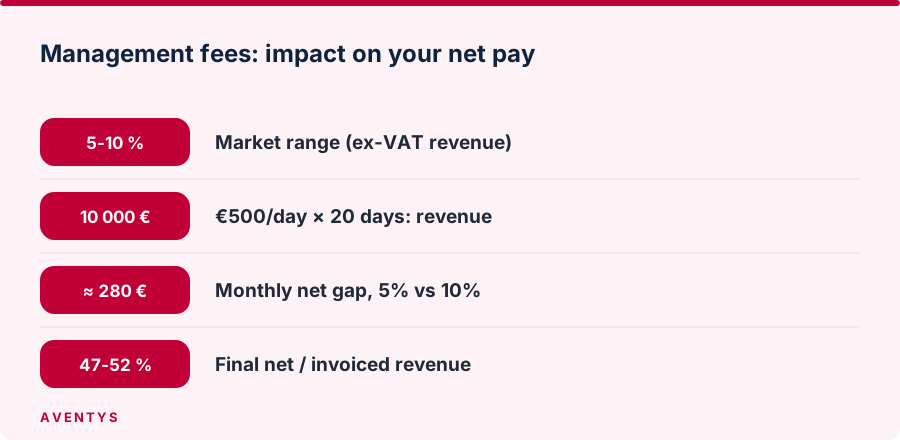
The real impact on your net pay: a €500 daily rate example
Take a consultant on a €500 daily rate billing 20 days a month, i.e. €10,000 of ex-VAT monthly revenue. Here is what the management-fee rate does to net pay before income tax, with employer contributions at roughly 42% of gross and employee contributions at roughly 22% (simplified calculation, before any expense optimisation):
| Management-fee rate | 5% | 7% | 10% |
|---|---|---|---|
| Monthly revenue (ex VAT) | €10,000 | €10,000 | €10,000 |
| Management fees | €500 | €700 | €1,000 |
| Left to convert into salary | €9,500 | €9,300 | €9,000 |
| Gross salary (≈ remainder / 1.42) | ≈ €6,690 | ≈ €6,550 | ≈ €6,340 |
| Net before income tax (≈ gross × 0.78) | ≈ €5,220 | ≈ €5,110 | ≈ €4,940 |
| Net / invoiced revenue | ≈ 52% | ≈ 51% | ≈ 49% |
Between 5% and 10% in fees, the gap reaches around €280 of net pay per month — more than €3,000 a year, the equivalent of six to seven billed days. These orders of magnitude confirm the general rule: net pay lands at 47-52% of invoiced revenue before optimisation. For the full mechanics, see our method to calculate your net salary in umbrella employment, or test your own figures in the net salary calculator.
Hidden charges to flush out before you sign
The advertised rate is sometimes only part of the real cost. Comb through the umbrella agreement on these points:
Entry and exit fees
Some companies charge "file-opening fees" at sign-up or closing fees when you leave. Neither is justified: opening an activity account is part of the core service. Their mere presence is a red flag about the overall transparency of the price list.
Fees on expense reimbursements
A critical and often invisible point: some companies apply their management fees to your entire revenue, including the portion meant to reimburse expenses rebilled to your client. Others charge a commission for processing expense claims. Over a year with travel, equipment and remote-working costs, the difference adds up to hundreds of euros. The topic deserves careful reading: see our guide to rebillable professional expenses and their impact on your net pay.
Other lines to watch
- Monthly minimum fee: a floor that penalises partial months and part-time billing;
- Between-assignment fees: charges maintained between two missions when no revenue is coming in;
- Salary advances: an extra commission if you want to be paid before the client settles the invoice;
- Tools and options: paid access to the tracking software, "enhanced" health cover or training modules.
How to negotiate your management fees
Management fees are a commercial price, not a statutory scale: they can be negotiated. Your levers, in order of effectiveness:
- Your billing volume: a €500-700 daily rate on a long assignment is a decisive argument. Position your rate properly first — our method to set your daily rate in umbrella employment will help;
- Visibility: a signed 6-12 month assignment is worth a preferential-rate commitment;
- A fee cap: if your revenue is high, ask for a monthly cap in euros rather than a mere rate discount;
- The calculation base: insist that fees apply to revenue excluding expenses rebilled to the client;
- Competitive pressure: schedules vary noticeably between providers; a written comparative quote speeds up the conversation.
Golden rule: everything you negotiate must appear in black and white in the umbrella agreement, including sliding-scale conditions and an exhaustive list of ancillary charges. A sales rep's verbal promise is worthless when you audit your activity account later.
Compare final net pay, not headline rates
A 5% rate combined with fees on reimbursements, a monthly minimum and separately billed liability insurance can cost more than an all-inclusive 8%. The only honest comparison is to ask each company for a written, itemised simulation of your exact situation: daily rate, billed days, projected expenses. Then check every month, on your activity account, that the actual deductions match the simulation. Any serious company provides this without fuss; a refusal or a vague simulation tells you everything.
FAQ: umbrella company management fees
Are management fees negotiable?
Yes. They are a freely set commercial price. Billing volume, assignment duration and competitive quotes are your strongest arguments. Get the outcome recorded in writing in the umbrella agreement.
Is a 5% rate automatically the best deal?
No. Check the calculation base, the ancillary charges (entry, exit, expense processing, between-assignment fees) and the company's solidity: mandatory financial guarantee, PEPS membership. Always compare the simulated final net pay, never the headline rate alone.
Do management fees reduce my social rights?
Indirectly, yes: deducted before your salary is calculated, they lower your gross pay and therefore the base for your pension contributions (general scheme plus Agirc-Arrco), unemployment rights and disability cover. One percentage point less in fees also means more social rights.
How do I verify the fees actually deducted?
Through your monthly activity account, which the umbrella company must make available to you. Reconcile every line against the contractual schedule: applied rate, calculation base, ancillary charges. Any discrepancy must be justified.
The right management-fee rate is the one that maximises your net pay on your actual billing profile. Put figures on your situation in two minutes with our net salary calculator, then book a call with an Aventys advisor for a detailed, line-by-line simulation tailored to your daily rate.