

Learning to negotiate your freelance daily rate is the highest-ROI skill an IT consultant can build. One well-prepared conversation can be worth more than a month of work: an extra €50 per day over a 200-day engagement adds €10,000 in billings — roughly €5,000 net under umbrella employment, where take-home pay typically lands between 47% and 52% of what you invoice. Yet most independents walk into that conversation unprepared, accept the first counter-offer, and sometimes negotiate against themselves.
This guide gives you a complete method: build your market benchmark, anchor high, answer the classic objections from end clients and staffing agencies with ready-to-use scripts, renegotiate mid-contract through an amendment, and secure an increase at renewal. The goal: never leave money on the table again.
Before you negotiate: build your market benchmark
A daily-rate negotiation is won before the first conversation. If you don't know the market range for your profile, you are negotiating blind — while the person across the table knows their rate grids by heart.
Three reference points to position your range
- Market grids by stack and seniority: cross-check the ranges published on mission platforms, feedback from your network, and what agency account managers let slip. A senior developer on an in-demand stack rarely sits below €500-600 per day; a cloud architect or cybersecurity expert frequently clears €700-800.
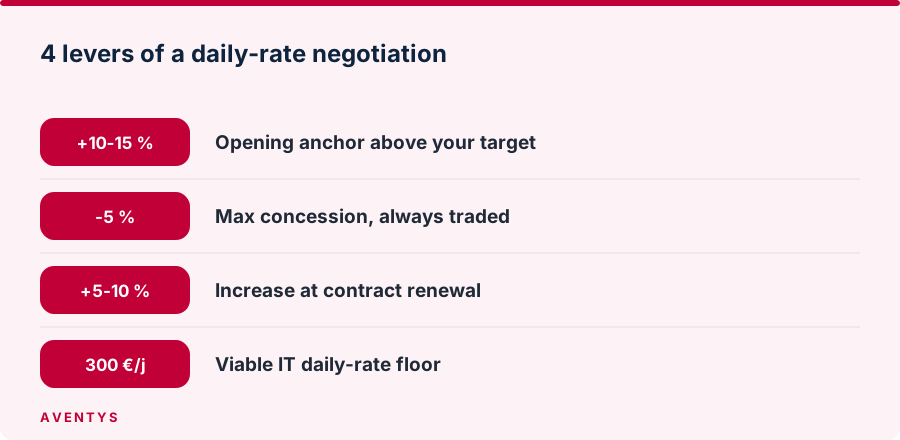
- The absolute floor: below roughly €300 per day, an IT engagement is not viable under umbrella employment — social contributions and the umbrella company's management fee (5 to 10% of billings) leave no acceptable net income. That threshold is a walk-away point, never a target.
- Your own history: your last accepted rate is your minimum starting point, never your ceiling.
To ground your numbers, the reverse-calculation method for setting your daily rate remains the reference: start from your target monthly net and work back to the rate you need.
Quantify business value, not skills
A client doesn't buy years of experience: they buy an outcome. Prepare two or three quantified achievements — "cloud migration delivered in four months instead of six", "build time cut by 30%", "team of five developers upskilled on Kubernetes". These reframe the discussion entirely: you are no longer defending a price, you are justifying an investment.
Negotiate your freelance daily rate with a high anchor
The first number on the table shapes everything that follows: that's the anchoring effect. Always open 10 to 15% above your real target. If you're aiming for €600, open at €660-680. Two outcomes: the client accepts — you just earned several thousand euros over the engagement — or they negotiate, and you land on your target while leaving them the feeling of having won a concession.
Three rules for a credible anchor:
- Quote a precise figure: "€675" is more credible than "around €700". A round number invites haggling; a precise number suggests a calculation.
- Don't justify immediately: state the figure, then stop talking. Silence is your ally — whoever speaks first after the number usually concedes.
- Never give a range: "between €600 and €650" means €600 to your counterpart. The lower bound instantly becomes your ceiling.
Answering the classic objections: scripts that hold
An objection is not a rejection — it's an invitation to negotiate. Here are the four most common, with responses that work.
"That's above our budget"
Response: "I hear you. What budget did you have in mind?" Always get the number before you move: a budget objection without a figure is often just a test. If the gap is real, negotiate scope rather than price: "At that budget I can cover the development but not the team coaching — would you rather reduce the scope or revisit the envelope?"
"Other candidates are cheaper"
Response: "Probably. The real question is: what does a profile cost that delivers three months later?" Steer the discussion to total project cost, not daily cost. A rate €100 lower that stretches the project by twenty days ends up costing the client more.
"Start at this rate, we'll raise it later"
Response: "Fine — let's put it in writing. At what date, and to what amount?" A verbal promise of an increase is worth nothing; require a written escalation clause in the commercial contract, for example +8% at month six if objectives are met. If the client refuses to write it down, the raise was never going to happen.
"Can you make a gesture?"
Response: never a free concession. Every discount is traded for something — a longer firm commitment, shorter payment terms, more remote days, reduced scope. "I can go to €640 on a firm six-month commitment" is infinitely better than a bare "OK, €640". And cap your total concession at about 5% of your anchor: beyond that, your opening figure loses all credibility.
Agency or end client: two different negotiations
You don't negotiate the same way with a buyer at the end client and with an agency account manager. The agency inserts its margin — often in the range of 15 to 25% — between your rate and what the client is billed. Knowing that sell rate changes the balance of power.
| Criterion | Agency / consultancy | End client |
|---|---|---|
| Counterpart | Account manager, incentivised on margin | Operational manager or procurement |
| Margin at stake | 15-25% between your rate and the client rate | No intermediary |
| Main lever | Knowing the rate billed to the end client | Comparison with an employee's full cost |
| Pace | Fast, framed by internal grids | Slower, budget sign-off required |
| Renegotiation window | At purchase-order renewal | At every scope extension |
With an agency, always ask what rate is billed to the end client: the answer — or the silence — tells you how much room you have. With an end client, your daily rate compares against the full cost of an equivalent employee (recruitment, employer contributions, management) and suddenly looks very reasonable. You can also target direct IT missions that remove the intermediary and its margin altogether.
Renegotiating mid-contract and at renewal
Mid-contract: the amendment
Has the scope changed — new responsibilities, an additional technology, a larger team? That is a legitimate ground for an amendment to the commercial contract. The rule: renegotiate when the change happens, not six months later. Script: "The initial scope covered X; I'm now being asked to handle Y. I propose an amendment at €650 to reflect that evolution." Under umbrella employment, you negotiate and your umbrella company formalises the amendment and secures the invoicing.
At renewal: your peak leverage
Renewal is when your negotiating power peaks: the client knows you, you've absorbed their context, and replacing you would cost months of lost productivity. A 5 to 10% increase at renewal is standard in the IT market. Announce it three to four weeks before the deadline, never the day before: "I'd like to continue. Given the current scope, my rate will move to €640 at renewal." Every euro gained flows through to your payslip: use the method for calculating your net salary under umbrella employment to measure the real impact of each step.
The fatal mistakes that cost you thousands
- Caving too fast: accepting the first counter-offer. If the client counters immediately, your figure is within budget — hold at least one more round.
- Negotiating against yourself: "€650… or €620 if that's too much." You just gave away €30 a day without being asked. One number, then wait for the answer.
- Revealing your previous rate: your history drags the discussion down. Talk about your current positioning, not your past.
- Negotiating without a walk-away point: decide before the meeting the rate below which you decline the mission. Without a floor set calmly in advance, you will concede under pressure.
- Signalling urgency: "I'm available immediately, I can be flexible" translates as "I'll take whatever you offer". Even between contracts, project calm.
FAQ: negotiating your daily rate with clients and agencies
How much can I raise my rate at renewal?
A 5 to 10% increase is common when the engagement has gone well. Beyond that, back your request with an objective scope evolution or strong market demand for your profile.
Should I disclose my previous daily rate?
No. Answer with your current positioning: "For this scope, my rate is €650." Your pricing history is nobody's business but yours.
Does the umbrella company negotiate for me?
No: you remain in charge of the commercial negotiation — that's the very principle of umbrella employment. The umbrella company formalises the agreed rate, invoices the client and secures your payments through the financial guarantee every umbrella company is legally required to hold.
Does a high rate increase reclassification risk?
No — rather the opposite: an expert-level rate consistent with genuine autonomy strengthens your positioning as an independent. What matters is how the engagement is executed, not the rate itself.
Before your next negotiation, put hard numbers behind your position: the daily rate calculator gives you the floor consistent with your target net income, and an Aventys advisor can review your positioning before the decisive meeting.