

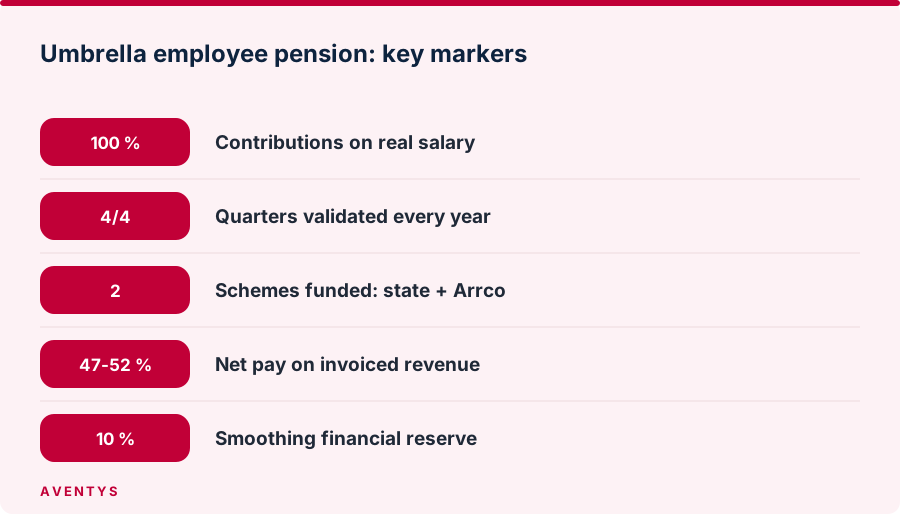
Your pension in umbrella employment works exactly like that of a permanent employee: you contribute to the French state scheme and to Agirc-Arrco on your real salary, not on a reduced flat-rate base. For an IT consultant, this is one of the strongest arguments for the status — and one of the least understood when choosing between an umbrella company, micro-entrepreneur status and a limited company.
Every euro of gross salary generated by your missions feeds your basic state pension and your supplementary points. Over ten or twenty years at a daily rate of €500 or more, the pension gap versus a classic freelancer adds up to hundreds of euros per month. This guide covers what you actually contribute, how your quarters are validated, how umbrella employment compares with other statuses, and how to build an end-of-career strategy: buying back quarters, combining work and pension, and topping up with a PER.
Pension in umbrella employment: two schemes funded on your real salary
Under umbrella employment, you are a fully-fledged employee of the umbrella company. Your pension contributions are therefore identical to those of any private-sector employee: the general social security scheme for the basic pension, and Agirc-Arrco for the supplementary scheme. They are part of the employer charges (around 42% of gross salary) and employee charges (around 22%) that appear on your monthly payslip.
The decisive point is the contribution base. Your rights are calculated on your real gross salary, which flows directly from the revenue you invoice. The higher your daily rate and your activity level, the higher your reference salary — and your future pension. The same mechanism opens up unemployment insurance, health cover and death-and-disability insurance, detailed in our guide to the social protection of umbrella employees.
Basic pension and Agirc-Arrco points: what each scheme counts
The basic pension takes into account your best salary years and the number of quarters you have validated. Agirc-Arrco converts every euro contributed into points, accumulated throughout your career and converted into an annuity at retirement. For a consultant whose gross salary exceeds the social security ceiling, the upper bracket contributes at a higher rate: strong end-of-career years generate proportionally more points.
Validating four quarters a year: near-automatic under an umbrella
Quarter validation does not depend on time worked, but on the amount of salary subject to contributions during the year. The minimum salary set by the umbrella industry agreement — around 77% of the monthly social security ceiling for full-time work — sits well above the required threshold. In practice, a full-time umbrella employee validates four quarters every single year.
Even an incomplete year protects you well: a few months of missions at a standard IT daily rate (€300 per day and up) are generally enough to validate the whole year, since the threshold is assessed on cumulative annual salary. The financial reserve of 10% of the base salary, required by the umbrella collective agreement of 22 March 2017, also smooths pay between missions and avoids contribution gaps.
Umbrella, micro-entrepreneur, limited company: which builds the best pension?
Pensions are where the gap between statuses is widest — and most often ignored at decision time. Micro-entrepreneur status attracts with its light flat-rate contributions, but that apparent saving costs you rights: the base used for your pension is only a fraction of revenue, far below the salary an umbrella employee would declare on the same turnover. A single-member limited company lets you arbitrate between salary and dividends, but dividends create no pension rights at all, neither in the basic nor in the supplementary scheme.
| Criterion | Umbrella employment | Micro-entrepreneur | Limited company (self-employed manager) |
|---|---|---|---|
| Contribution base | Real gross salary | Flat-rate fraction of revenue | Manager's remuneration only |
| Basic pension | General scheme, full rights | Reduced rights on equal revenue | Depends on chosen remuneration |
| Supplementary scheme | Agirc-Arrco (executive points) | Self-employed scheme, less generous | Self-employed scheme, less generous |
| Quarters when full-time | 4/4 guaranteed | Depends on declared revenue | Depends on salary actually paid |
| Dividends possible | No: everything becomes salary | No | Yes, but zero pension rights |
Take a consultant invoicing €108,000 a year excluding VAT (€500 × 18 days × 12 months). Under an umbrella, after management fees (5 to 10% of revenue, often on a sliding scale) and social contributions, they take home roughly 47 to 52% of what they bill — but their entire gross salary, in the order of 60 to 65% of revenue, funds the state scheme and Agirc-Arrco. As a micro-entrepreneur or with dividend-heavy company structures, immediate cash may look higher; the pension rights accumulated are markedly lower. Our comparison of umbrella employment vs classic freelancing quantifies this gap.
Buying back quarters: filling career gaps
Long studies, years abroad, early ventures with thin contributions: IT careers are rarely linear. The French buy-back mechanism lets you purchase missing quarters for higher-education years or incomplete working years. The cost depends on age and income at purchase time, and rises with age: the earlier you decide, the cheaper it is.
A detail that often settles the matter for umbrella employees: buy-back payments are deductible from taxable income. For a senior consultant in a high marginal tax bracket, the real effort after tax savings is substantially reduced. The calculation is worth running around age 50-55, when your remaining career and missing quarters become clear.
Combining pension and work: invoicing through an umbrella after retirement
Umbrella employment is probably the simplest framework for continuing to invoice after drawing your pension. No structure to create or manage, one-off missions accepted on your own terms, and employee status with its social coverage maintained. If you meet full-rate conditions, the full work-and-pension combination lets you receive pension and salary with no cap; otherwise, combining remains possible but capped.
Under certain conditions, the full combination can even generate new pension rights since the latest reform. For an in-demand IT expert — architecture, cybersecurity, data — two or three billed days a week comfortably top up a pension, with no structure to run.
End-of-career strategy for the senior consultant
Make your final salary years count
The basic pension counts your best years; Agirc-Arrco accumulates points without any duration limit. Well-filled final years at a senior daily rate therefore count twice. Watch the expense trade-off, though: every euro processed as professional expenses raises your immediate net pay but escapes contributions, so it creates no rights. The optimisation described in our article on professional expenses under umbrella employment remains relevant, but at the very end of a career it can be rational to dial it down and maximise contributory salary.
A PER to top up the mandatory schemes
The individual French retirement savings plan (PER) complements the mandatory schemes: voluntary payments are deductible from taxable income up to an annual ceiling, with an exit in capital or as an annuity. For an umbrella employee whose marginal tax rate reaches 30% or more, the tax leverage is real, and the smoothed monthly salary of umbrella employment makes scheduled payments easy.
FAQ — pension and umbrella employment
Does umbrella employment validate pension quarters?
Yes. You contribute to the general scheme like any employee, and salary levels in umbrella employment — a contractual minimum around 77% of the monthly social security ceiling — guarantee in practice four validated quarters per year when working full-time.
Do umbrella employees contribute to Agirc-Arrco?
Yes, on real salary, like any executive employee. That is the major difference with micro-entrepreneur and self-employed statuses, whose supplementary schemes are less generous at equivalent income.
Can I combine my pension with umbrella missions?
Yes. The work-and-pension rules apply to umbrella employees: uncapped if you retired at the full rate, capped otherwise. An umbrella company saves you from creating a structure just for a few post-retirement missions.
Do management fees reduce my pension rights?
Indirectly: they are deducted from revenue before your salary is calculated, so one point less in management fees means more contributory salary. Hence the value of sliding-scale or capped fees.
Today's daily rate determines tomorrow's pension. Measure how your billing converts into contributory salary with our umbrella net salary calculator, or book a call with an Aventys advisor to build your consultant retirement strategy.