

Landing your first freelance mission under umbrella employment is often the most intimidating step in the move to independence. You know your craft, but selling your expertise, pricing your work and convincing a first client are skills a salaried career never asked you to build. The good news: winning that first contract follows a known playbook, and the umbrella employment framework removes much of the friction.
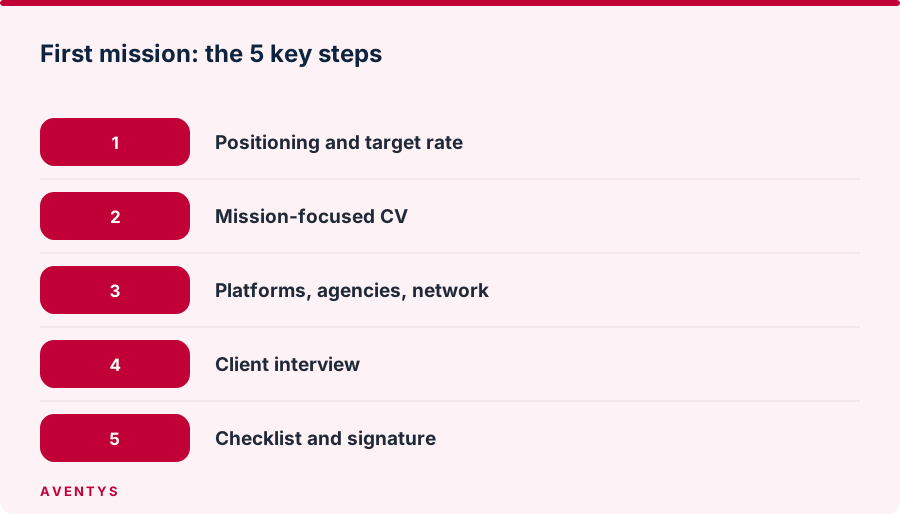
This guide walks through the entire journey: positioning, mission-focused CV, prospecting channels, client interviews, first-contract traps and a pre-signature checklist. With one underrated thread running through it all: your status as an umbrella company employee reassures clients as much as it protects you.
Nail your positioning before you prospect
Prospecting without positioning means sending generic applications that drown in the pile. Before any outreach, be able to answer three questions in one sentence: what problem do I solve, for which type of client, with what proof. "Full-stack developer" is not a positioning; "I stabilise and industrialise React/Node applications for fast-growing scale-ups" is.
Define a legible offer
List your last three significant achievements in employment: a cloud migration, an application overhaul, an infrastructure cost reduction. These are your references, even if you delivered them as an employee — the client wants to know whether you can repeat them, not under which status you did them.
Set a credible daily rate from day one
The classic beginner mistake: discounting your rate "to get started". An underpriced daily rate undermines your credibility as much as your income. Under umbrella employment, your net pay lands at roughly 47-52% of billed revenue, after the umbrella company's management fee (5-10% of revenue) and social contributions; below around €300 per day, the model is not viable in IT. The reverse-calculation method starts from your target net income: aiming for around €4,000 net per month means billing in the region of €8,000, i.e. a daily rate of about €440 over 18 billed days. The daily rate calculator gives you your number in two minutes.
Mission CV vs employee CV: switch mental models
The CV that got you hired on a permanent contract will not win you a client. A recruiter buys long-term potential; a client buys an immediately operational skill set. Your consultant profile — the format agencies and end clients expect — must reflect that difference.
- The headline is your offer, not your last job title: "AWS DevOps Consultant – CI/CD, Kubernetes, FinOps".
- Experience framed as missions: context, problem, actions, quantified outcomes.
- An explicit, prioritised tech stack: production-grade skills first, with recent versions.
- Availability and terms: start date, on-site presence if possible.
Strip out everything that belongs to a salaried career path. The decision-maker reads this document in 90 seconds; every line must answer one question: "can this person solve my problem next month?"
Winning your first freelance mission through umbrella employment: which channel?
Three main channels dominate the IT mission market, each with a very different logic when you have no freelance track record yet.
| Channel | Typical lead time | Rate level | Fit for a first mission |
|---|---|---|---|
| Freelance platforms | 2-8 weeks | Average, heavy competition | Good for generating first contacts |
| IT services firms and consultancies | 2-6 weeks | Tightly negotiated | Well suited to profiles without a track record |
| Direct client | 2-6 months | Highest | Hard without network or references |
| Professional network | Often fast | Fair to high | Excellent: trust is already established |
Work these channels in parallel rather than in sequence: a complete profile on two or three IT-focused platforms, targeted applications to consultancies that place independent contractors, and a close watch on published mission openings — Aventys regularly posts client needs across France and Luxembourg.
Your network: the strongest lever for a first contract
Most first missions are signed through direct relationships: former colleagues who became decision-makers, managers now working client-side, contractors met on past projects. These people already know the quality of your work — you only need to announce your availability. Reach out individually to around twenty selected contacts: your offer in one sentence, your start date, an explicit request for an introduction.
On LinkedIn, switch your profile to consultant mode: a headline aligned with your offer, quantified achievements, and a post announcing your launch. A former employer can even become your first client — provided you keep genuine autonomy in how you deliver, to stay clear of any disguised employment risk.
Ace the client interview: sell a solution, not a profile
A mission interview is not a job interview. The client wants to verify three things: your technical fit for their specific context, your autonomy, and the risk they take by handing you the subject.
- Research the context: product, stack, organisation. Ten minutes of preparation already sets you apart.
- Ask consultant questions: what triggered the need, what has already been tried, how will success be measured?
- Tell outcomes, not tasks: "I cut deployment time by a factor of three" carries more weight than "I was in charge of CI/CD".
- State your daily rate without flinching: a rate delivered calmly, backed by reasoning, negotiates far better.
Clarify the contractual setup during the interview itself: under umbrella employment, the umbrella company signs the commercial contract with the client and issues the invoices.
First contract: traps to avoid and the pre-signature checklist
The classic beginner traps
- A vague scope: without written deliverables, the mission expands indefinitely at a fixed rate.
- The "we'll review the rate later" promise: it rarely materialises — negotiate the right rate upfront.
- Excessive payment terms: beyond 45-60 days, renegotiate.
- Over-integration into the client's teams: imposed hours, de facto reporting lines — the classic ground for reclassification as disguised employment.
The checklist before you sign
- Daily rate, projected days and renewal terms in writing.
- Mission duration, notice period and early-exit conditions.
- Client payment terms and late-payment penalties in the commercial contract.
- Rebillable expenses (travel, equipment) listed before the start.
- A vetted umbrella company: mandatory financial guarantee under French law, transparent management fees, ideally a member of PEPS, the industry body.
Why umbrella employment reassures your first client
For a client, working with a consultant under an umbrella arrangement removes nearly all administrative friction: a standard commercial contract with an established company, clean invoicing, professional liability insurance included, no payroll or contribution management on their side. The legal framework provides a level of traceability that individual statuses do not always offer.
On your side, you start with a full safety net: employee-grade social protection, pension contributions based on your actual salary, unemployment rights. You prospect without the fear of the void — which changes everything in a negotiation. For the full mechanics, see our guide on how umbrella employment works.
FAQ – First freelance mission and umbrella employment
Can you start under umbrella employment with no freelance experience?
Yes — it is the most common scenario. Your salaried years are your references: the client buys your expertise, not your seniority as an independent.
How long does it take to land a first IT mission?
From three weeks to three months, depending on your specialty and your network. Cloud, data and cybersecurity profiles move fastest.
What minimum daily rate makes a first mission viable?
Around €300 per day is the viability floor in IT. Most first daily rates sit between €350 and €500 depending on the specialty.
Should you accept a lower rate to win a first reference?
A 5-10% concession, limited in time, can be defensible. A 30% discount locks you into a pricing grid that is hard to escape.
Ready to turn your expertise into a first mission? Estimate your real take-home pay with our net salary calculator, or book a call with an Aventys advisor to secure your first contract in France or Luxembourg.