
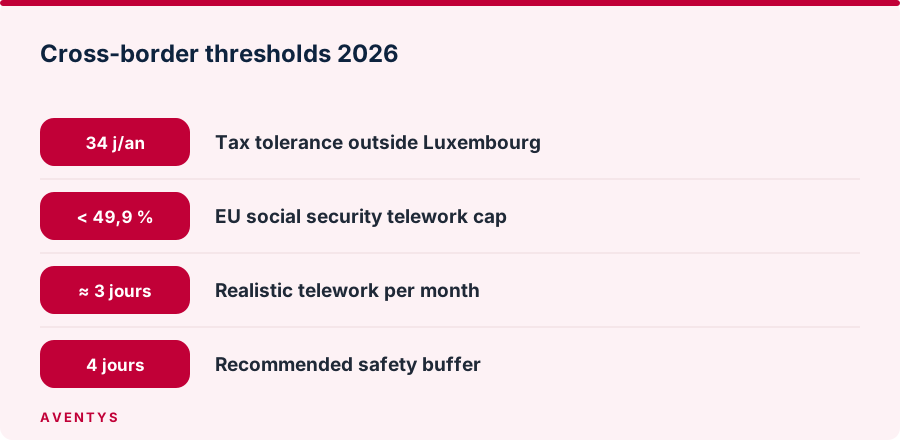
Living in France while billing a client in Luxembourg is everyday life for thousands of IT consultants. Yet cross-border telework Luxembourg umbrella arrangements are governed in 2026 by two very different ceilings: a tax tolerance of 34 teleworking days per year outside the Grand Duchy, and a social security cap set at 49.9% of working time by the European framework agreement. Two texts, two administrations, two counting methods — and very real consequences for your net pay if you cross either line without noticing.
This guide covers how each threshold works, how days are counted, what you risk if you exceed them, and how to organise a realistic working week — flagging at every step what changes in umbrella employment, where your legal employer is the umbrella company.
Cross-border telework in Luxembourg umbrella employment: two thresholds, not one
The classic mistake is believing there is "a" telework threshold for cross-border workers. There are two, coming from independent legal sources:
- The tax threshold: 34 days per year. It stems from the France-Luxembourg tax treaty and determines where your remuneration is taxed.
- The social security threshold: less than 49.9% of working time. It stems from the European framework agreement on cross-border telework and determines which social security system covers you.
Complying with one never exempts you from checking the other. For a full-time consultant, 34 days represent roughly 15% of annual working time — so the tax threshold is almost always the first to bite. A consultant teleworking two days a week is perfectly safe on the social security side (40% of working time) but burns through the tax quota by spring.
The tax threshold: 34 telework days tolerated outside Luxembourg
As long as you stay within 34 days worked outside Luxembourg over the year, your entire remuneration remains taxable in the Grand Duchy. This tolerance avoids splitting your salary between two tax administrations over a handful of home-office days.
How is a telework day counted?
The count is stricter than it looks:
- A fraction of a day counts as a full day: a one-hour video call from your home in France can consume one day of quota.
- Days worked in a third country (a client meeting in Paris, a training course in Brussels) also count towards days worked outside Luxembourg.
- Annual leave, public holidays and sick leave do not count: only days actually worked enter the calculation.
What happens beyond 34 days?
Exceeding the threshold cancels the tolerance: the share of remuneration corresponding to days worked outside Luxembourg becomes taxable in France. In practice you file in both countries, your umbrella company must apportion your pay, and while the two administrations reconcile, you are exposed to partial double taxation before regularisation.
Social security: the 49.9% rule of the European framework agreement
Under the European framework agreement on cross-border telework, signed by both France and Luxembourg, a cross-border worker may telework up to 49.9% of their working time from their country of residence while remaining affiliated to the social security system of the employer's country. For a consultant employed by a Luxembourg umbrella company, that means keeping Luxembourg affiliation as long as telework stays a minority of working time.
Beware: this continuity is not automatic. It requires a formal request from your employer — your umbrella company — to the competent institution, a point to lock down before signing your umbrella agreement. For what this affiliation covers in practice (healthcare, pension, provident cover), see our guide to social protection for umbrella employees.
Tracking your days: the discipline that protects your status
Both thresholds share one requirement: evidence. In the event of an audit, you and your employer must demonstrate where each day was worked.
- Keep a daily log: date, place of work, client, type of activity. A simple spreadsheet filled in as you go is enough.
- Keep material proof: access badges, shared calendars, toll or train tickets.
- Align your monthly activity report: the report you send your umbrella company should mention work locations.
This is a clear advantage of umbrella employment over running your own company: the umbrella company centralises activity reports, can alert you as you approach the thresholds and issues the employer certificates administrations request. A cross-border freelancer with a single-person company handles all of this alone.
Exceeding the thresholds: the concrete risks
Three possible situations for an umbrella consultant living in France and working for a Luxembourg client:
| Situation | Taxation | Social security |
|---|---|---|
| Up to 34 days outside Luxembourg and less than 49.9% telework | Fully taxable in Luxembourg | Luxembourg affiliation maintained |
| More than 34 days but less than 49.9% telework | Days outside Luxembourg taxable in France, filings in both countries | Luxembourg affiliation maintained |
| Telework at 50% of working time or more | Tax apportioned between the two countries | Switch to French social security, contribution regularisation |
The social security switch is the heaviest scenario: your employer must then contribute to the French system, with employer contributions of around 42% of gross salary and employee contributions of around 22%, possible retroactive recalculation and a direct impact on your net pay. By contrast, an isolated tax overrun is settled through cross-filings — tedious, but reversible.
A typical week and a worked example for a cross-border IT consultant
Take a DevOps consultant billing a €650 daily rate in Luxembourg City: around €11,700 of monthly revenue for 18 billed days. After the umbrella company's management fee (5 to 10% of revenue excluding VAT) and social contributions, net pay lands between 47 and 52% of invoiced revenue — roughly €5,500 to €6,100 per month. Refine this figure with our net salary calculator or the detailed method in our article on calculating net salary in umbrella employment.
In terms of organisation, 34 days a year translates into roughly 3 telework days per month — not one per week. The most robust strategy:
- Plan a maximum of 30 telework days for the year, not 34: keep 4 days in reserve for the unexpected (strikes, snow, a sick child).
- Batch your home-office days: three Fridays a month rather than scattered half-days.
- Count every day outside Luxembourg against the quota: a client meeting in Paris or a conference in Lyon eats into the 34 days.
- Review the counter quarterly with your umbrella company.
What umbrella employment changes for the cross-border consultant
In umbrella employment, your employer is not your client: it is the umbrella company. When it is established in Luxembourg — like Aventys, an IT-focused umbrella company based in the Grand Duchy and operating in France and Luxembourg — you sign a Luxembourg employment contract, receive a Luxembourg payslip and hold classic cross-border worker status. The Luxembourg employer then handles the affiliation-continuity paperwork.
The umbrella framework adds two further safeguards: the mandatory financial guarantee that secures salary payment, and a financial reserve of 10% of base salary on permanent contracts provided by the sector's collective agreement. For the full cross-border picture, read our article on umbrella employment in Luxembourg and internationally.
FAQ: cross-border telework in umbrella employment
Are the 34 days counted per calendar year?
Yes, the quota applies per calendar year with no carry-over: days unused in 2026 are lost.
Does half a day of telework consume a full day?
Prudently, yes: a fraction of a day worked outside Luxembourg is generally counted as a full day.
Who must prove compliance in an audit?
You and your employer — your umbrella company. A day log, monthly activity reports and presence evidence form your file of proof.
What happens if I telework more than 50% of my time?
You switch to French social security: your employer must contribute there, your contributions are recalculated and your net pay changes. Discuss the scenario with an advisor first.
Every cross-border situation deserves precise framing before you sign. Book a call with an Aventys advisor: together we validate your telework organisation, your daily rate and your projected net pay before day one of your assignment.