

Combining employment and umbrella work is entirely legal in France. Nothing prevents an employee on a permanent contract — full-time or part-time — from invoicing consulting missions through an umbrella company alongside their job. It is in fact one of the safest ways to test a career as an independent IT consultant: you keep your fixed salary, your social protection and your seniority while building a client portfolio. But that freedom comes with precise rules that many consultants discover too late.
Exclusivity clauses, the duty of loyalty, working-time ceilings, whether to inform your employer, the special regime for civil servants, and the taxation of two salaries: this guide walks through every checkpoint before you sign your first umbrella agreement — and the signals that tell you it is time to go 100% umbrella.
Combining employment and umbrella work: a right, with conditions
The starting principle is freedom of work: outside your contractual hours, your time is your own. Umbrella employment is a form of salaried work — you sign an employment contract with the umbrella company, which invoices your clients and pays you a salary — so combining a regular permanent contract with umbrella activity is, legally speaking, a classic case of holding two salaried jobs, a common situation governed by the French labour code. If the umbrella mechanism is still unclear to you, start with our guide on how umbrella employment works.
Three conditions make the combination lawful: not breaching any clause of your existing employment contract, staying within the maximum working-time limits across all your activities, and remaining loyal to your main employer. Each deserves a serious check, because an irregular combination can justify dismissal for misconduct.
Three contract clauses to check before invoicing anything
The exclusivity clause
This is the first lock. An exclusivity clause prohibits any other professional activity, salaried or not, for the duration of your contract. It is common in IT executive contracts. To be enforceable, it must be justified by the nature of your role and proportionate; in a part-time contract its validity is even more restricted. If your contract contains one, do not ignore it: negotiate a written waiver, even a temporary one, before starting your first umbrella mission.
The non-compete clause
It formally targets the period after your contract ends, but its spirit already applies while you are employed: you cannot run an activity that directly competes with your employer. Concretely, a developer employed by an IT services firm who invoices identical services to the same pool of clients through an umbrella company takes a real risk. The safe route: pick missions in a distinct technical, sector or geographic scope.
The duty of loyalty
Even without any written clause, it binds every employee. It prohibits poaching your employer's clients, using their equipment, licences or data for your missions, and of course working on your umbrella projects during your contracted hours. The boundary is easy to remember: umbrella missions happen on your own time, with your own tools, for clients who are not your employer's.
Maximum working time: the ceiling nobody calculates
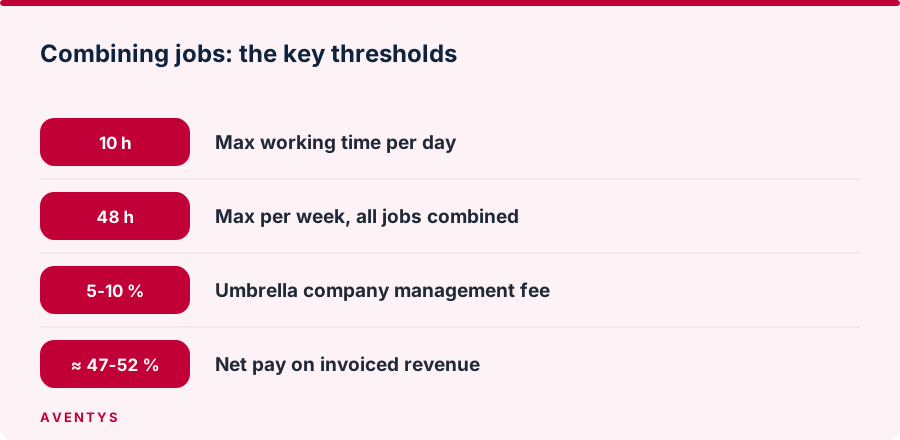
This is the most concrete limit on any combination. French labour law caps working time at 10 hours per day and 48 hours per week, across all salaried activities combined. Since umbrella work is salaried employment, your mission days add up with your regular job's hours.
Do the maths: with a 35-hour permanent contract, you have roughly 13 billable hours left per week — the equivalent of one to two mission days. With a half-time contract, you can bill up to three days a week without friction. That is why the combination works best in two configurations: occasional missions alongside a full-time job (audits, short expert assignments), or a regular umbrella activity built on top of a part-time contract.
Do not take this ceiling lightly: any employer may ask you for a sworn statement that you respect maximum working times, and a proven breach constitutes misconduct that can justify dismissal.
Should you tell your employer?
Private sector: no general obligation
Unless a clause says otherwise, a private-sector employee does not need authorisation to hold a second salaried activity, nor to disclose the identity of their clients. However, if your employer asks whether you respect the working-time caps, you must answer truthfully. Our advice: if your umbrella missions sit close to your day job's field, a short factual written notice defuses most potential conflicts.
Civil servants: a tightly restricted combination
The logic is reversed in the public sector: civil servants are bound by a non-accumulation principle, with limited exceptions. An ancillary activity can be authorised upon written request to the hierarchy, for occasional work such as training or short expert assignments. Agents on part-time or incomplete schedules have broader options, always subject to authorisation. A civil servant planning regular umbrella activity must therefore obtain formal approval before invoicing anything, or face disciplinary sanctions.
| Situation | Combination possible? | Key conditions |
|---|---|---|
| Private permanent contract, no exclusivity clause | Yes | Loyalty + caps of 10 h/day and 48 h/week |
| Private contract with exclusivity clause | No, unless waived | Negotiate a written waiver before any mission |
| Private part-time contract | Yes, ideal setup | Exclusivity clauses rarely enforceable |
| Civil servant | Restricted | Hierarchical authorisation, ancillary activity only |
Taxes and social protection: how your two salaries fit together
The combination produces two payslips, each with its own contributions. On the umbrella side, the mechanics are well known: from your invoiced revenue, the umbrella company deducts its management fee (5 to 10% of revenue excluding VAT, often degressive), then employer contributions (around 42% of gross) and employee contributions (around 22%) apply. In the end you receive roughly 47 to 52% of your revenue as net pay, before any optimisation through professional expenses.
For income tax, your two salaries are added together and taxed under the progressive scale. Withholding tax applies to each payslip: remember to update your personalised rate to avoid a catch-up bill the following year. The good news on the rights side: you accrue pension rights (general scheme plus Agirc-Arrco) on the sum of your two actual salaries, and you build training-account (CPF) rights under both contracts.
A concrete example: a consultant on a half-time permanent contract (€1,400 net) who bills 4 days a month at a €500 daily rate generates €2,000 of umbrella revenue — roughly €940 to €1,040 of additional net pay. Monthly income rises from €1,400 to around €2,400, with pension rights calculated on the whole.
When should you switch to 100% umbrella employment?
The combination is a launch ramp, rarely an end state. Three signals tell you the moment has come: your pipeline consistently exceeds what the working-time caps allow you to serve; your daily rate has stabilised well above the viable floor in IT (around €300/day, and ideally €450 to €600 for an experienced profile); and your monthly umbrella net matches your salary. To put numbers on that last point, our reverse-calculation method for setting your daily rate helps you price correctly.
Let's quantify the switch: at a €500 daily rate and 18 billed days per month, you generate €9,000 of revenue — roughly €4,200 to €4,700 net per month, often well beyond an equivalent IT salary. And the transition can be secured: a mutually agreed termination of your permanent contract opens your unemployment (ARE) rights, which act as a safety net during the first months of full-time umbrella activity.
FAQ: combining a salaried job with umbrella work
Can I combine a full-time permanent contract with umbrella work?
Yes, provided no exclusivity clause prevents it, and within the caps of 10 hours per day and 48 hours per week across all contracts. In practice, that limits umbrella work to occasional missions of one to two days per week.
Can my employer forbid me from working through an umbrella company?
Only with a valid exclusivity clause, or if your umbrella activity directly competes with them or breaches your duty of loyalty. Outside those cases, your free time is yours.
Does the combination improve my pension?
Yes. You contribute to the general scheme and to Agirc-Arrco on both actual salaries: the combination mechanically increases your rights, unlike some self-employed statuses.
Do I declare my two salaries separately for tax?
No: both are pre-filled and added together in your single tax return. Just check your withholding rate to avoid a catch-up payment.
Before you commit, measure what your combination would really pay: our umbrella net salary calculator converts your daily rate and billed days into monthly net pay, and an Aventys advisor can review your contract clauses during a free call.